Residential properties across Los Angeles County operate on water heater infrastructure that ranges from compact 1920s closets in Silver Lake and Echo Park bungalows to expansive utility garages in Brentwood and…
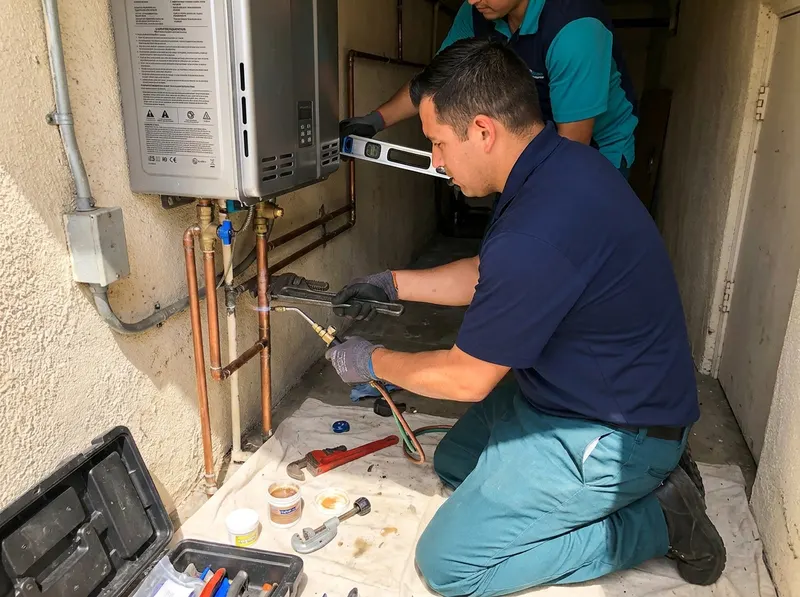
Residential properties across Los Angeles County operate on water heater infrastructure that ranges from compact 1920s closets in Silver Lake and Echo Park bungalows to expansive utility garages in Brentwood and Sherman Oaks. A tankless water heater conversion requires distinct mechanical conditions compared to standard 40-gallon tank swaps. Tankless units demand natural gas inputs between 150,000 and 199,000 BTUs per hour, whereas legacy atmospheric tanks require roughly 40,000 BTUs. Installing a tankless system often requires upgrading supply lines from a standard 1/2-inch pipe to a dedicated 3/4-inch line routed directly from the gas meter to prevent pressure drops. In older neighborhoods like Los Feliz, Highland Park, and Hancock Park, existing masonry chimneys or B-vent conduits cannot carry acidic exhaust from high-efficiency systems; technicians run dedicated twin polypropylene or stainless steel venting horizontally through exterior stucco walls.
Selecting the right capacity hinges on concurrent fixture usage and cold-water intake temperatures. In coastal zones like Venice, winter groundwater averages 55 degrees Fahrenheit, requiring a 65-degree rise to reach a 120-degree output. A 9.0 gallon-per-minute unit comfortably powers two simultaneous showers and a washing machine under these metrics. If an active burst or structural tank failure is currently leaking onto drywall in a Studio City or Koreatown residence, immediate isolation of the cold water shut-off valve prevents framing decay while technicians calculate system loads. Converting from a tank to a tankless footprint frees up 9 to 12 square feet of interior floor space, but the structural trade-off involves upfront utility alignment: homes lacking a nearby 120-volt electrical outlet require dedicated wiring to power the digital controller and internal freeze-protection heating elements.
1. Water supply and gas lines are isolated, and the damaged tank is drained using a high-temperature transfer pump.
2. The tankless unit is secured to wall studs using seismic-rated steel mounting brackets required by Los Angeles safety mandates.
3. The gas feed line is upgraded to 3/4-inch black iron piping and sealed with a high-capacity shut-off valve.
4. Dual isolation flush valves are fitted to the copper cold inlet and hot supply lines for yearly descaling operations.
5. Intake air and Category IV exhaust venting are routed to the exterior, followed by electronic manifold calibration and water pressure balancing.
Every job gets a firm, written price after a free on-site visit.
Tell us about your tankless water heater installation job in los angeles and we'll send a clear, written quote, usually the same day.
 Los Angeles HandyPro